
Temperature or quantity ?
The boiling point of a chemical compound is often considered the minimum temperature at which it vaporizes and becomes available for inhalation. This is why many people aim to heat their vaporizers to specific temperatures, to target particular molecules and achieve different effects.
Unfortunately, this interpretation does not quite align with the physical reality of vaporization. I suspect that the variations in experience reported at different temperatures stem primarily from differences in total quantity absorbed, rather than from differences in the specific types of compounds being absorbed.
Here is my reasoning.
Misinterpreted data
Many websites feature tables showing the boiling points of substances found in hemp extracts. The vast majority of these tables are partially incorrect, or more accurately, misinterpreted.
Take cannabidiol (CBD) for example. It is often stated that its boiling point is between 160 °C and 180 °C. This is true, BUT only under near-zero atmospheric pressure, the kind of conditions used in vacuum distillation. This has nothing to do with the typical conditions under which an extract is vaporized at standard atmospheric pressure.
In reality, the boiling point of CBD at ambient atmospheric pressure is likely above 400 °C (cannot be measured, only calculated), far exceeding the temperatures reached during normal vaporization (a maximum of 230–240 °C). Yet, it is still possible to vaporize CBD molecules using a vaporizer!
To understand why, let’s look at an example that everyone will be familiar with.
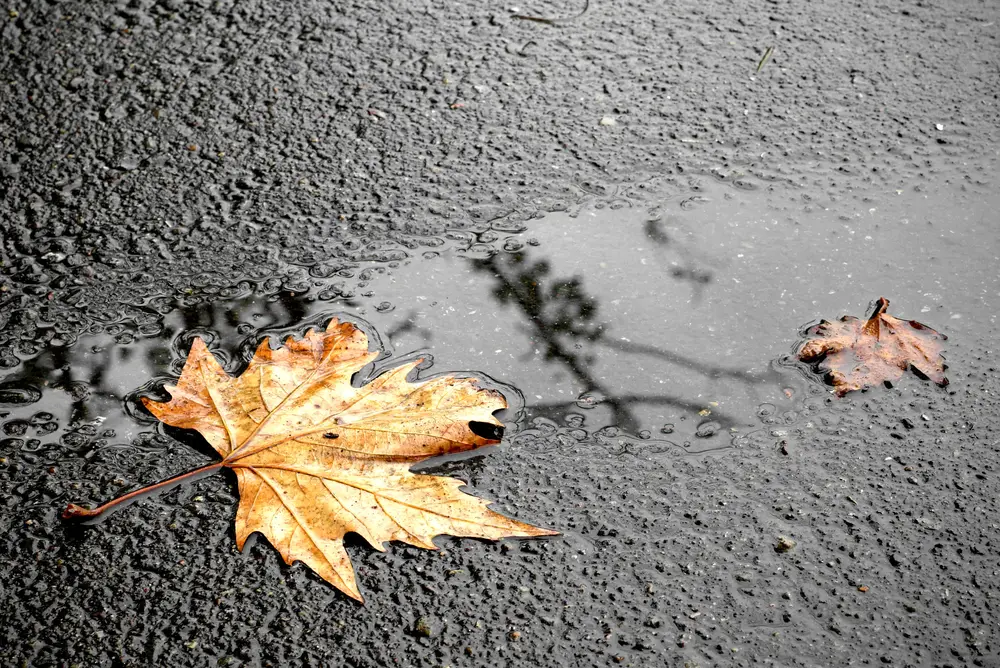
A puddle in the street
A puddle in the street disappears within a few days once it stops raining. The water has evaporated into the air, transitioning from a liquid state to a gaseous state: it has been vaporized.
Yet, the ambient temperature (10–30 °C) is far below the boiling point of water (100 °C). Therefore, the vaporization of a substance does not begin at its boiling point, but rather well before that, through the process of evaporation. Evaporation is a form of vaporization.
A bit of physics
Volatility is the measure used to describe a substance’s capacity to vaporize, not its boiling point (though they are related).
The volatility of a substance is defined as the ratio of its proportion in the gas phase to its proportion in the liquid phase when the two phases are in equilibrium.
In more practical terms, any solid or liquid substance naturally loses some of its molecules to the atmosphere over time; this process is known as evaporation. The number of molecules lost to the atmosphere per unit of surface area and time depends directly on the substance’s temperature and its inherent nature; the pressure exerted by those free molecules within the atmosphere is known as their partial vapor pressure.
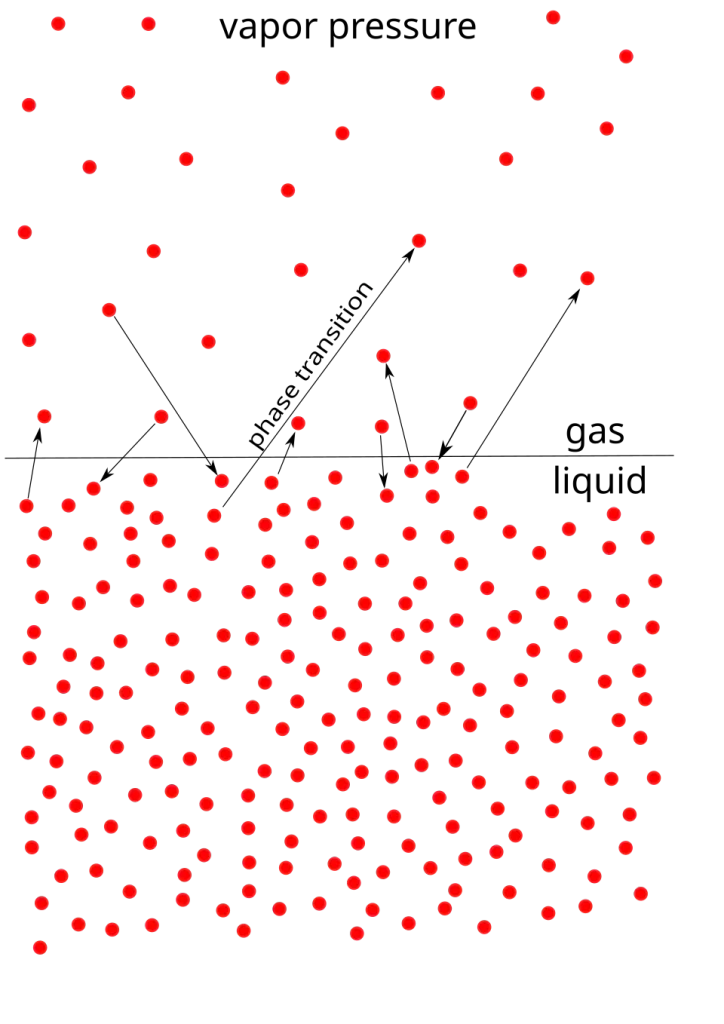

However, the atmosphere cannot contain an infinite amount of a given substance; beyond a certain partial vapor pressure, which itself depends on the nature of the substance and its temperature, molecules that have vaporized into the atmosphere will condense (reverting to a solid or liquid state), thereby limiting the partial vapor pressure that the substance can reach.
This maximum partial vapor pressure, which varies with temperature, is known as the saturation vapor pressure. It can be represented as a curve showing pressure as a function of temperature, as illustrated in the graph below for water.
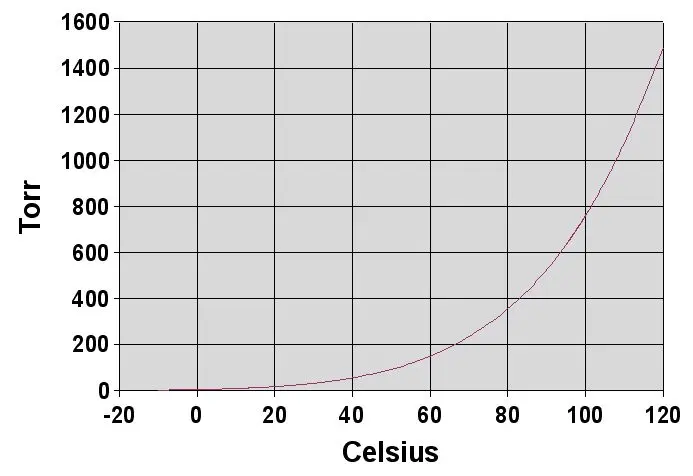

When the saturated vapor pressure of a substance equals atmospheric pressure (760 Torr at sea level), the substance has reached its boiling point (in the case above, 100 °C).
The higher a substance’s saturated vapor pressure at a given temperature, the more volatile it is. Therefore, comparing the saturated vapor pressure curves of several substances makes it possible to compare their volatility at a given temperature.
Temperature and rate of vaporization
When a substance is vaporized below its boiling point while the surrounding atmosphere is continuously being replaced, as is the case during inhalation with a vaporizer, the temperature at which vaporization occurs has a big impact on the amount of the compound inhaled. This is because the substance’s saturated vapor pressure is never reached within an atmosphere that is constantly being renewed (i.e. inhaled).
When humidity is below 100 %, a puddle of water will evaporate in a few days at 10 °C, but in only a few hours at 30 °C.
For the substances typically found in hemp extracts, experiments show that a 20 °C increase in vaporization temperature can nearly double the amount vaporized over the same period. In other words, vaporizing at 220 °C can release 3 to 4 times more of a given substance than vaporizing at 180 °C (a 2×2 increase, corresponding to two 20 °C increments) over the same duration, a massive difference!
Thus, vaporizing a substance at a low temperature, below its boiling point, primarily serves to limit its rate of vaporization, rather than preventing it entirely.
The right quantity rather than the right temperature
Boiling point is not this absolute ON/OFF criterion that many people assume it to be when it comes to vaporization.
As illustrated in the chart below, which shows calculated saturated vapor pressures curves for compounds commonly found in hemp extracts, the difference in volatility between families of molecules (i.e. the difference in their saturated vapor pressures) is so significant at typical vaporization temperatures (180–230 °C) that it is only feasible to target a specific family of molecules, namely, those with low boiling points, such as monoterpenes, rather than any single, specific molecule, especially those with high boiling points.
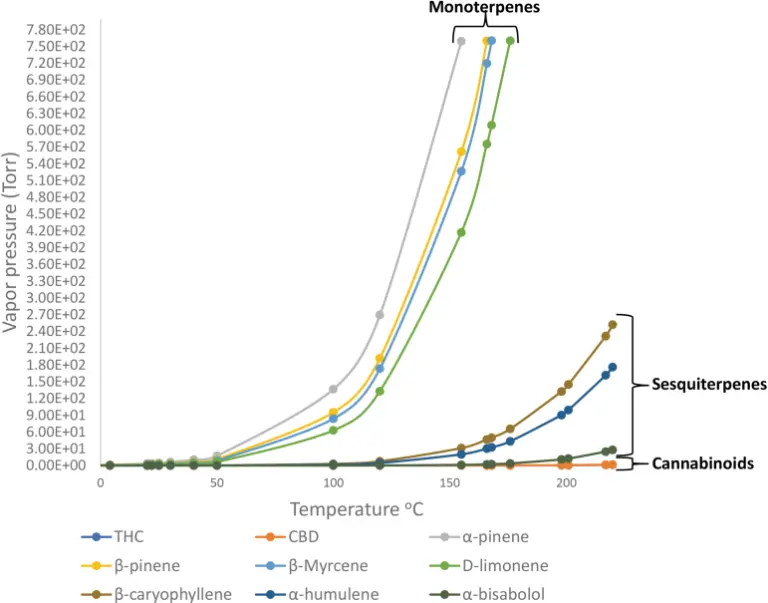
The vaporization temperature is still a critical factor; it must be managed to avoid burning or degrading delicate molecules, such as many monoterpenes, that have boiling points below the target vaporization temperature. This is why a cold-start approach is recommended: it allows these highly volatile molecules to vaporize at a lower temperature before the extract reaches its final, higher vaporization temperature, which would otherwise cause them to degrade, and gives its flavors to the first puff of a new micro-bowls.
During this phase, the extract boils vigorously, which is typically limited to the first one or two puffs. As the most volatile substances disappear, the bubbling subsides as a sign that the process is transitioning from boiling to evaporation.
For the molecules that remain after this boiling phase, such as certain cannabinoids (CBG, CBD) which have boiling points that are both similar to one another and higher than standard vaporization temperatures, attempting to target a specific molecule by maintaining a low and constant temperature is generally ineffective. These molecules tend to vaporize together, albeit at slightly different rates.
Furthermore, the overall rate of vaporization becomes very slow, resulting in minimal vapor production and a largely unsatisfying experience. It also often leads to wasted material, as a portion of the extract may never fully vaporize: the time required for complete evaporation increases significantly (by a factor of 3 or 4 when dropping the temperature from 220 °C to 180 °C).
For this reason, I believe the same result could have been achieved by simply using a smaller amount of extract and ensuring that it is vaporized completely.
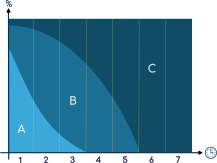
Therefore, knowing the composition of your extract so that you can load the right amount and vaporize it until dry (i.e. until no more vapor is produced) at an appropriate temperature strikes us as far more efficient (economical) and respectful of the effort that went into producing the flowers and the extract (ensuring nothing goes to waste).
Conversely, relying solely on low-temperature vaporization often results in the loss of active compounds, as they may take too long to evaporate and thus never end up being consumed.
To explore this topic further, we recommend reading this study, or this one, or perhaps this other one, which discuss the content remaining in dried flowers after they have been vaporized (AVB).

Found an error on this page? Let us know here!