Sipqo’s story
My name is PLF and the Sipqo vaporizer has been my main passion-project for the last few years. The reasons that drove me to develop it are certainly not unique to me and others might find them interesting, as well as the key stages of its development. So, here is why and how it was created.
Narrowing down on the issue
It all began in 2019, after I quit smoking and decided to switch to vaporization. Several months of using various vaporizers had shown me I didn’t really enjoy any of them: cumbersome power cords, batteries that took forever to charge and had short lifespans, long initial heat-up times, over-sized cooling chambers, the list went on.
More importantly, I had realized I didn’t like the taste of vaporized flower! Not the first draw, which was often delicious, but the following puffs always left a lingering taste reminiscent of straw mixed with licorice root, which I found nauseating. Furthermore, the throat hit was highly unsatisfying for the young former smoker that I was.
I briefly considered limiting my consumption to just one or two draws per session to mitigate these issues, but that would have resulted in significant waste of compounds left unvaporized within the plant material (a common issue with many dry-herb vaporizers, as documented in this study or this one). But the practical drawbacks mentioned earlier would still remain. That was when the idea of developing my own vaporizer began to take root.
Development start
The initial design specifications consisted of just a few key points. The vaporizer had to be:
- simple, so that I could design it and have it manufactured;
- convenient to use and easy to clean;
- free of electrical cords or batteries;
- specifically designed for
full-meltextracts, because of their superior aromatic qualities and the absence (or near-absence) of non-vaporizable plant matter, in order to avoid the unpleasant taste mentioned earlier; - capable of true
on-demanddelivery with acold-start, to replicate the convenience of smoking as closely as possible.
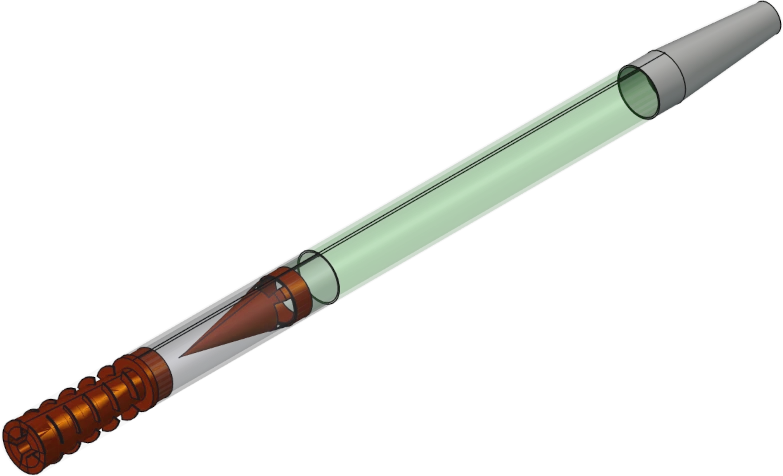
The early designs around mid-2020 lacked a little inspiration, as illustrated below by one of the initial iterations that was explored and subsequently abandoned.
But after a few months of research, model-making, and all sorts of experiments, by mid-2021, I had a digital 3D model that I found interesting:
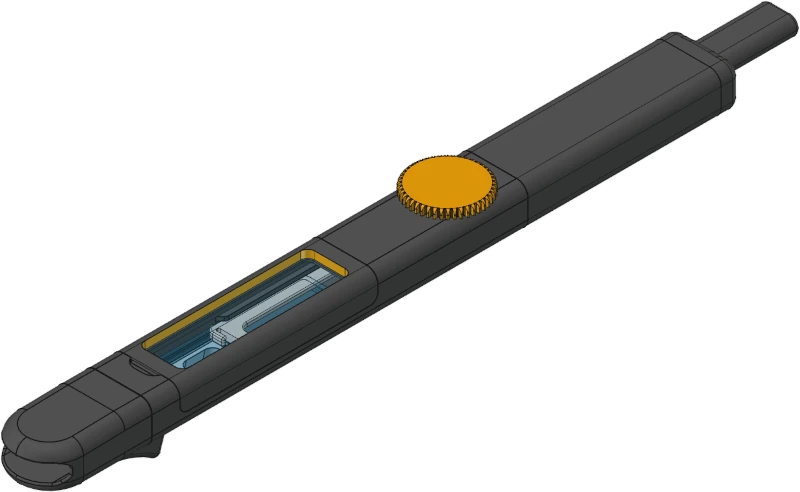
A viewing window to observe the vaporization process, a movable tray with multiple micro-bowls, and a stop mechanism to correctly positioning the lighter, all the core foundational elements of the current Sipqo vaporizer were there.
The micro-bowls were crafted by hand, the mechanism to move the tray via the yellow dial was imperfect (overly complicated) and lacked haptic feedback, and the viewing window was not yet removable, but on paper, it worked.
Making it a reality
Furthermore, this model could be produced by anyone with access to the 3D files, by utilizing on-demand metal 3D printing services that cater to individual customers.
And so, after a few weeks of waiting, Sipqo (codenamed ‘Unas‘) became a reality:
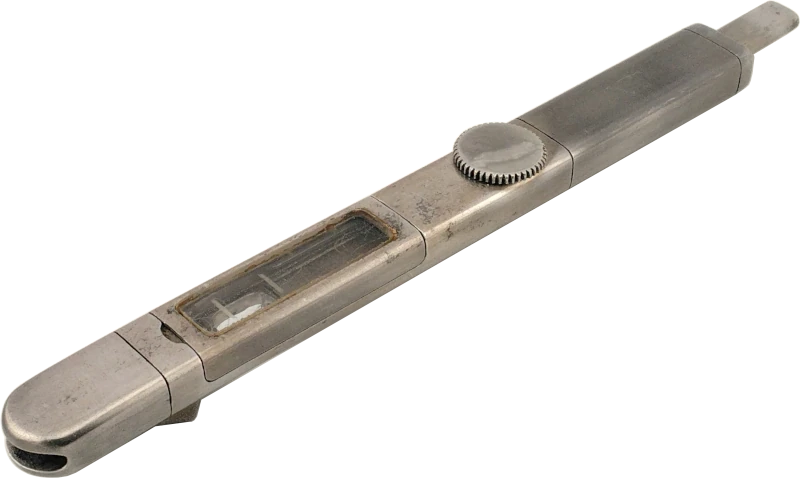
(without anodization, areas that come into contact with fingers, as well as scratches and other marks, oxidize more quickly than the rest of the surface, which is highly unattractive)
Unfortunately, the initial vaporization tests proved to be very disappointing. No matter how hard I tried to heat most of the micro-bowls using a strong flame, they barely heated up, and the vaporization was mediocre at best. However, some of the micro-bowls worked quite well, which was at least encouraging!
Crafting the micro-bowls by hand using a tool designed specifically for that purpose also proved to be rather difficult, and at times even dangerous (risk of cuts).
I then spent the following weeks trying to figure out why vaporization was so ineffective for the majority of the micro-bowls, though with little success at first. Fortunately, a bout of laziness came to my rescue, a rare enough occurrence to be worth noting!
In an effort to minimize the number of micro-bowls I had to produce, given how difficult they were to make, I chose to keep using each one for as long as possible. Over time, I began to notice something: the older, more dented, and generally uglier a micro-bowl became, the better it performed, to the point it actually allowed for proper vaporization!
After a few more trials, I had finally understood what made the micro-bowls functional and capable of effective vaporization, even when brand new.
A bad idea
With a vaporizer now operational, I began to think it would be interesting to write a construction and user manual and share the blueprints, so that anyone who wished could build their own vaporizer.
However, I soon realized that enabling just anyone to manufacture such a product was both highly impractical and dangerous:
- the manufacturing cost for a single vaporizer exceeded 1’000 €;
- the production process remained very long and laborious (even if it could be improved);
- the vaporizer comes into contact with the user’s mucous membranes, yet the vast majority of aluminum alloys used for 3D printing are not food-safe (at least, they weren’t at the time);
- this same health-related concern applies to all other materials used in the vaporizer, given how they are utilized (sometimes heated to over 200 °C);
- an aluminum part produced via 3D printing requires a protective anodized coating which must be food-grade, yet anodizing 3D-printed parts is far from ideal due to the specific aluminum alloys used (which contain too much silicon);
- etc.
Consequently, I continued using my vaporizer for a while, on my own. Once properly calibrated, it now worked perfectly. But I increasingly felt it was a shame that it remained confined to my own personal use.
Redesign
In 2022, I finally decided to step things up and seek professional help to simplify the design and make it ready for industrial-scale production, with the goal of bringing it to market at a reasonable price.
So I got in touch with a local design and engineering agency, and we began our work. Given the rather unique nature of the product, the initial months of redesigning were not the most productive; however, four key ideas emerged:
- splitting the vaporizer horizontally into an upper and a lower shell, rather than using vertical segments;
- completely eliminating the tray-movement mechanism, which was overly complex and contained too many parts, replacing it with a simple notch on the side of the vaporizer;
- making the glass pane replaceable and gasket-free by securing it with a removable stainless-steel spring wire;
- utilizing that same spring wire to also hold the tray in various positions, ensuring the micro-bowls are correctly aligned with the chimney.
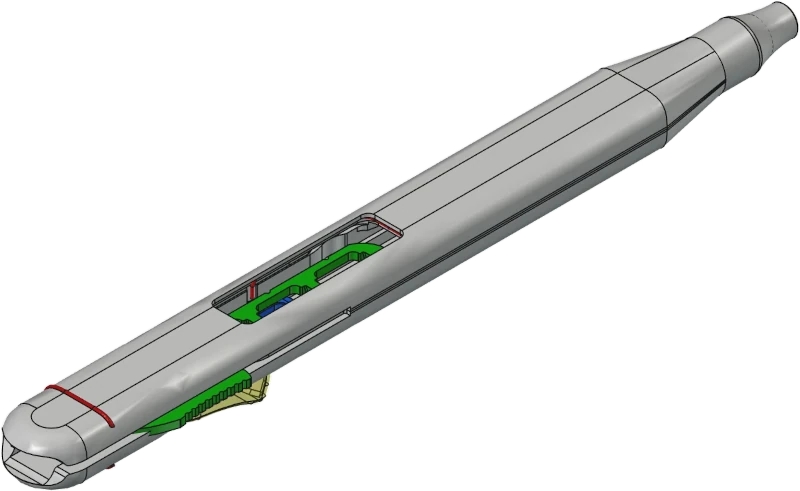
Then, with the arrival of a new mechanical designer on the project, a constructive dialogue began and we quickly made significant progress.
First, we slightly modified the connection between the outer shells and the mouthpiece to make it easier to use. Next, the design of the notches and the interlocking mechanism for the upper and lower shells was revised to increase durability. The mechanism to adjust and secure the stopper was also completely overhauled to improve user convenience. Finally, the micro-bowls and their interface with the steel frame (using clips) were redesigned to allow for large-scale mass production via metal stamping.
In early 2024, an initial prototype was produced to validate the redesign, which helped identify a few further minor improvements. I then tested a variety of steel frame shapes to determine which one offered the best vaporization, ensuring efficient heating without causing the extract to burn (too quickly).
By the end of 2024, a second prototype was produced as part of a small-batch run, followed by several months of intensive testing to validate its performance under real-world conditions.
The adventure begins
Satisfied with the results, the company Xpqo was established in August 2025 to officially launch production of the Sipqo vaporizer. After several months spent sourcing the right suppliers for each part, production finally got underway in late 2025.
And here we are, end of 2026, after more than a few sleepless nights, shipments of non-compliant parts sent back to the factory, and various other setbacks, ready to officially launch the website you are currently viewing, which I have truly enjoyed building over the past few weeks.